
A Rovo tool is a single calculation Rovo can run against your Jira data — one action with defined inputs and outputs. Time in Status provides eight of them. You don't run a tool directly — you ask an agent a question, and it reaches for the tool that fits. Any agent can use these tools, including agents your team builds.
Before you begin
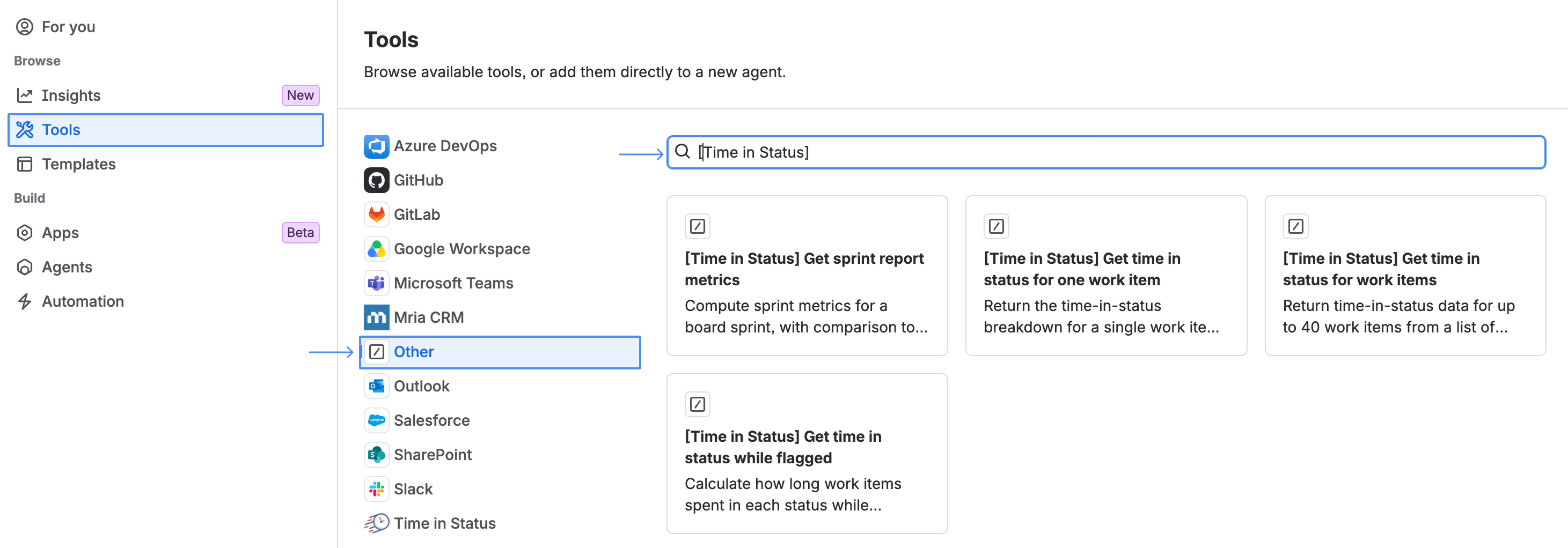
Time in Status tools are available on Jira Cloud only. Your Jira admin must enable Rovo as a Jira feature. Once Time in Status is installed, its tools appear in the Tools directory — search Time in Status to list them all. Each tool carries the [Time in Status] prefix; the newly added tools also appear under Time in Status in Connected apps (Rovo Studio → Browse → Tools).
ℹ️ Previously listed as skills. Atlassian now separates agent capabilities into Tools and Skills. These calculations are Tools — the four carried-over ones work exactly as before; only the category and where you find them have changed.
Tools at a glance
|
# |
Tool |
What it measures |
Ask something like |
Inputs you can mention |
What you get back |
Notes & limits |
Category |
|---|---|---|---|---|---|---|---|
|
1 |
Get status count for work item 🆕 |
How many times a single work item entered each status |
"How many times did ABC-123 go back into In Progress?" |
Work item (key or ID); report period* |
Per status, how many times the item entered it. Creation counts as the first entry into the initial status; statuses never entered are omitted. Matches the Status count report on the global page. |
No work schedule applied. |
Time in Status |
|
2 |
Get status entrance date for work item 🆕 |
The date a single work item first entered each status |
"When did ABC-123 first reach In Review?" |
Work item (key or ID); report period* |
Per status, the date & time of the first entrance (later re-entrances excluded). Creation = first entrance into the initial status; statuses never entered are omitted. |
Times shown in the user's Jira time zone (stated in the result). No work schedule input. |
Time in Status |
|
3 |
Get time in assignee for work item 🆕 |
How long each assignee held a single work item, by work schedule |
"Who held ABC-123, and for how long each?" |
Work item (key or ID); report period*; optional work schedule ( |
Per assignee, the total time the item was assigned to them. Time with no assignee is a separate Unassigned entry. |
Durations in pretty format (d h m s). A view of ownership and handoffs, not individual productivity. |
Time in Status |
|
4 |
Get transition count for work item 🆕 |
The count of status transitions, by From → To pair |
"How often did ABC-123 move between statuses?" |
Work item (key or ID); report period* |
The number of status transitions, broken down by From → To pair. |
No work schedule. If the item never changed status: "{key} hasn't changed status since it was created." |
Time in Status |
|
5 |
Get time in status for one work item |
The time-in-status breakdown for a single work item |
"How long has ABC-123 been in each status?" |
Work item (key or ID); whether to recalculate from change history; work schedule by ID |
Total time (creation → now or close); time per status with its share of the item's life; every entry into and exit from each status; the item's summary. |
A work schedule carries its own time zone. |
Time in Status + Other |
|
6 |
Get time in status for work items |
Time-in-status data for up to 40 work items from a list of keys |
"Compare time in status for the bugs in this sprint." |
Up to 40 keys (duplicates dropped); recalculate from history (default yes); how many to process (1–40); work schedule by ID |
The same breakdown as row 5, for every item in the set. |
Up to 40 work items per request. |
Other |
|
7 |
Get sprint report metrics |
Sprint metrics for a board sprint, compared with recent sprints |
"How did this sprint compare to the last three?" |
Board & sprint; estimation basis (item count / story points / original estimate); earlier sprints to compare (0–7, default 3); time zone |
Completion; estimation values; velocity vs. earlier sprints; status & work-type distribution; sprint details (name, state, dates). |
Estimation basis sets the unit for every value. One board sprint at a time. |
Other |
|
8 |
Get time in status while flagged |
How long work items spent in each status while flagged |
"Where did flagged work items get stuck last month?" |
Work items (JQL, filter by ID, or filter by name); date range; statuses to count or ignore; time zone; a limit on how many items |
Total flagged time; that time broken down by status; how many items were scanned and how many stages had flagged time. |
Time zone defaults to UTC. |
Other |
Add these tools to your own agent
When you create a Rovo agent, you choose its tools from the Tools directory. Time in Status tools appear alongside tools from every other installed app — the [Time in Status] prefix tells you which tools come from this app and groups them together.
.png?cb=15405d071849b557a2044be4cbf9153e)
Give your agent tools that match the questions you expect it to answer. An agent that reports on sprints needs the sprint metrics tool; an agent that chases blocked work needs the flagged time tool and one of the time-in-status tools for follow-up detail.
Agents that use these tools
Time in Status ships two agents built on these tools: FlagFocus, for tracking blocked work, and Sprint report insights for sprint reporting. You can use either without building an agent of your own.
Limitations
-
Each request must finish within 55 seconds — a limit of Atlassian Forge. A question covering many work items, or work items with long change histories, can reach that limit and return an error instead of results. Narrow the date range, the filter, or the number of work items and ask again.
-
These tools read work item history and Time in Status field values. They cannot change work items, move them between statuses, or edit any field.