
In SLA Time and Report, calendars (work schedules) define when SLA time is counted.
They control working time, meaning the time during which your team is actually available to work. So, SLA time is calculated only during working hours defined in the calendar.
By default, SLA time can be tracked 24/7, but with calendars, you can limit it to your team’s actual working hours.
How SLA time is calculated with calendars
SLA time is calculated based on the selected working schedule. Instead of counting all elapsed time, the system counts only the time that falls within defined working hours.
Example
-
Working hours: 09:00 – 17:00 (Monday–Friday)
-
SLA start: Friday at 16:00
-
SLA stop: Monday at 10:00
Actual SLA time:
-
Friday → 1 hour (16:00–17:00)
-
Weekend → not counted
-
Monday → 1 hour (09:00–10:00)
✔ Total SLA time = 2 hours, not 66 hours
Create a work schedule
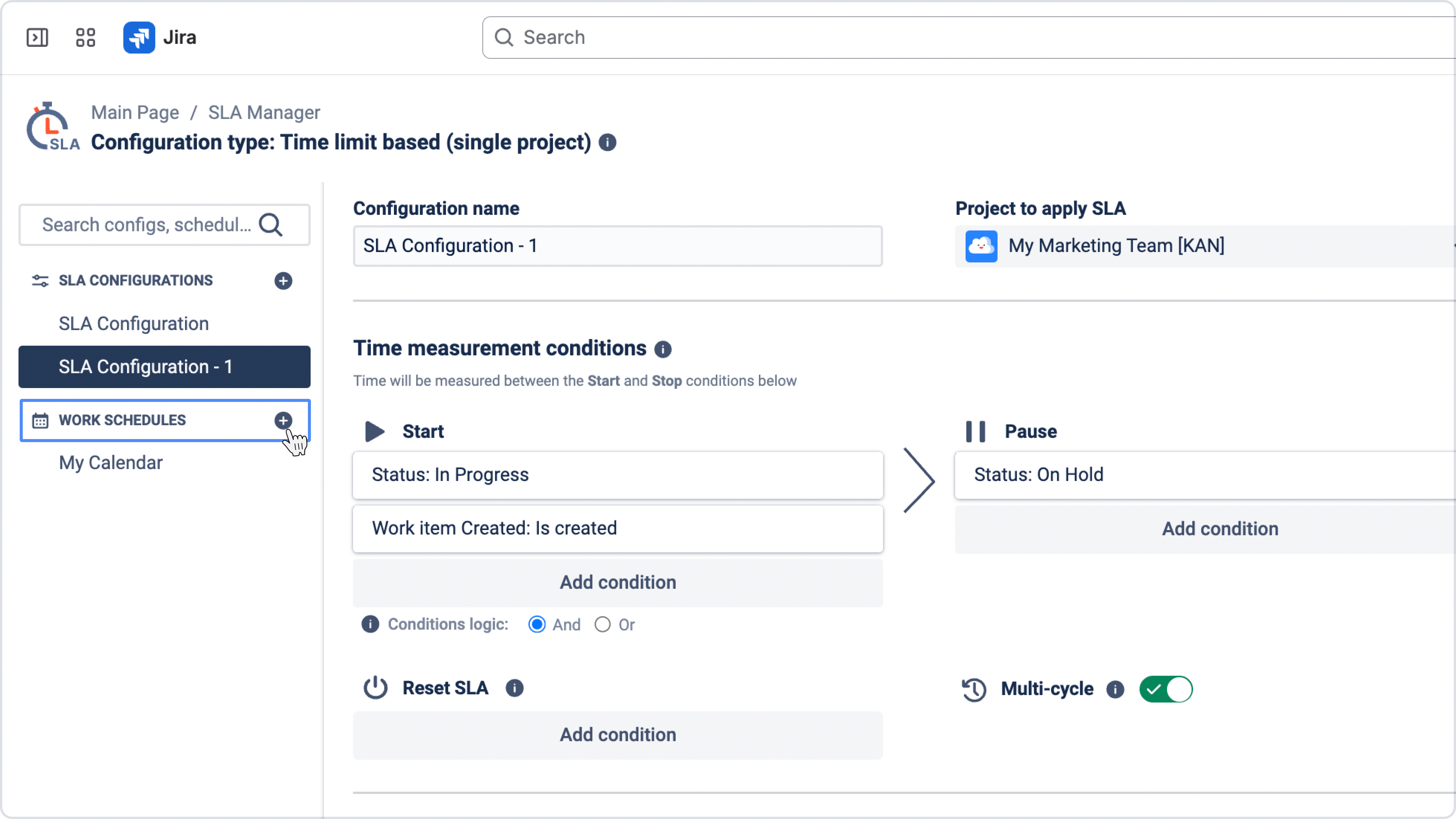
To create a new calendar (work schedule):
-
Open the SLA configuration page

-
Go to the Work Schedules section

-
Click

Basic setup
In the Add work schedule menu you can choose:
-
Schedule name – for example, Support Team Schedule
-
Time zone – affects SLA calculation
-
Working days – select the days your team works
-
Working hours – define the time range for each working day
.jpg?cb=4fbff1caf0466e5aac77c5ab5a5064e3)
Advanced settings
You can also configure:
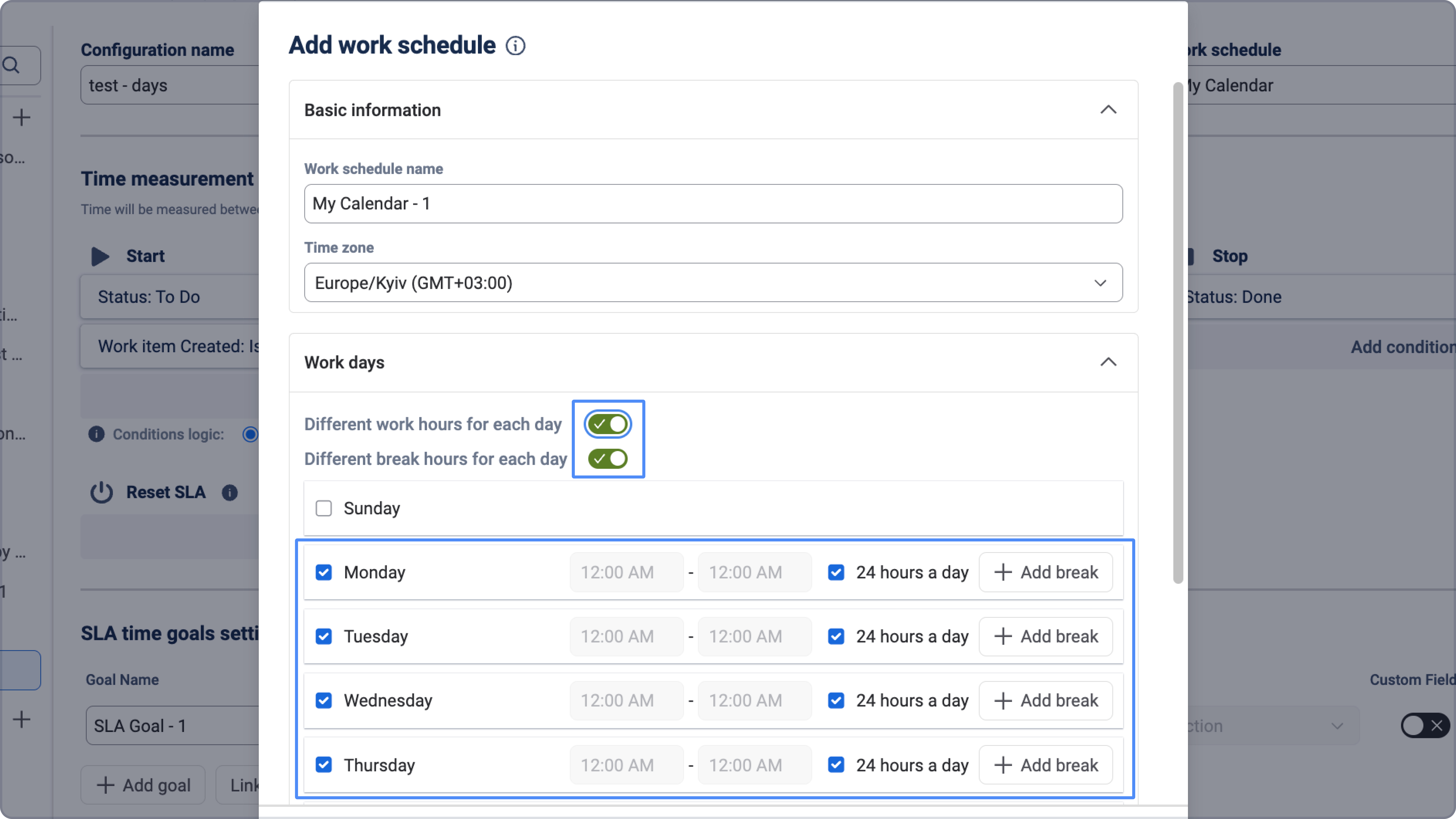
Different working hours per day
Enable Different work hours for each day to set individual schedules for each day. You can set individual working hours and breaks for each day. To do this, enable the Different work/breaks hours for each day button.
Breaks and 24/7 schedule
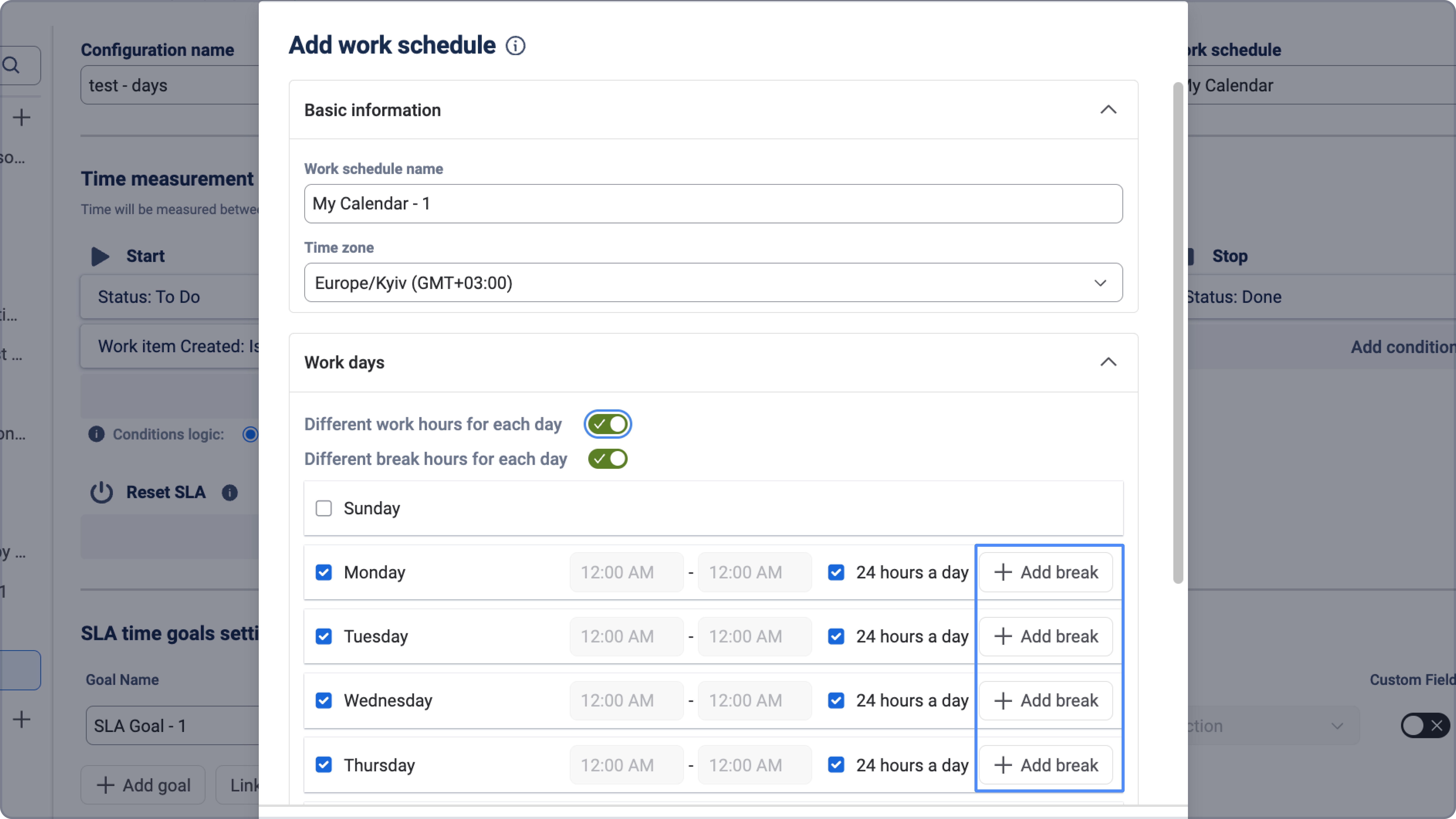
Enable Different break hours for each day and add break periods (for example, lunch time). Breaks are not counted as working time.
In order to set a 24-hour working schedule for all days, enable the checkbox before 24 hours a day. To set the same breaks for all days, fill in the name field and Add a break.
Business day length
Set the Length of Business days for the SLA goals time limit field. By default, 1 day (1d) equals 8 hours, but you can change it from 1 to 24 hours.
.jpg?cb=1b239288d4846eff90868c2f8cbcca64)
Holidays
Use the Holidays section to exclude public holidays, company holidays, or other non-working days from SLA calculation.
Holidays are not counted as working time. If an SLA is active during a holiday, the timer pauses for that non-working period and continues when the next working time starts.
Add public holidays
Enable Add public holidays :Switcher: to automatically add public holidays for a selected country or region.
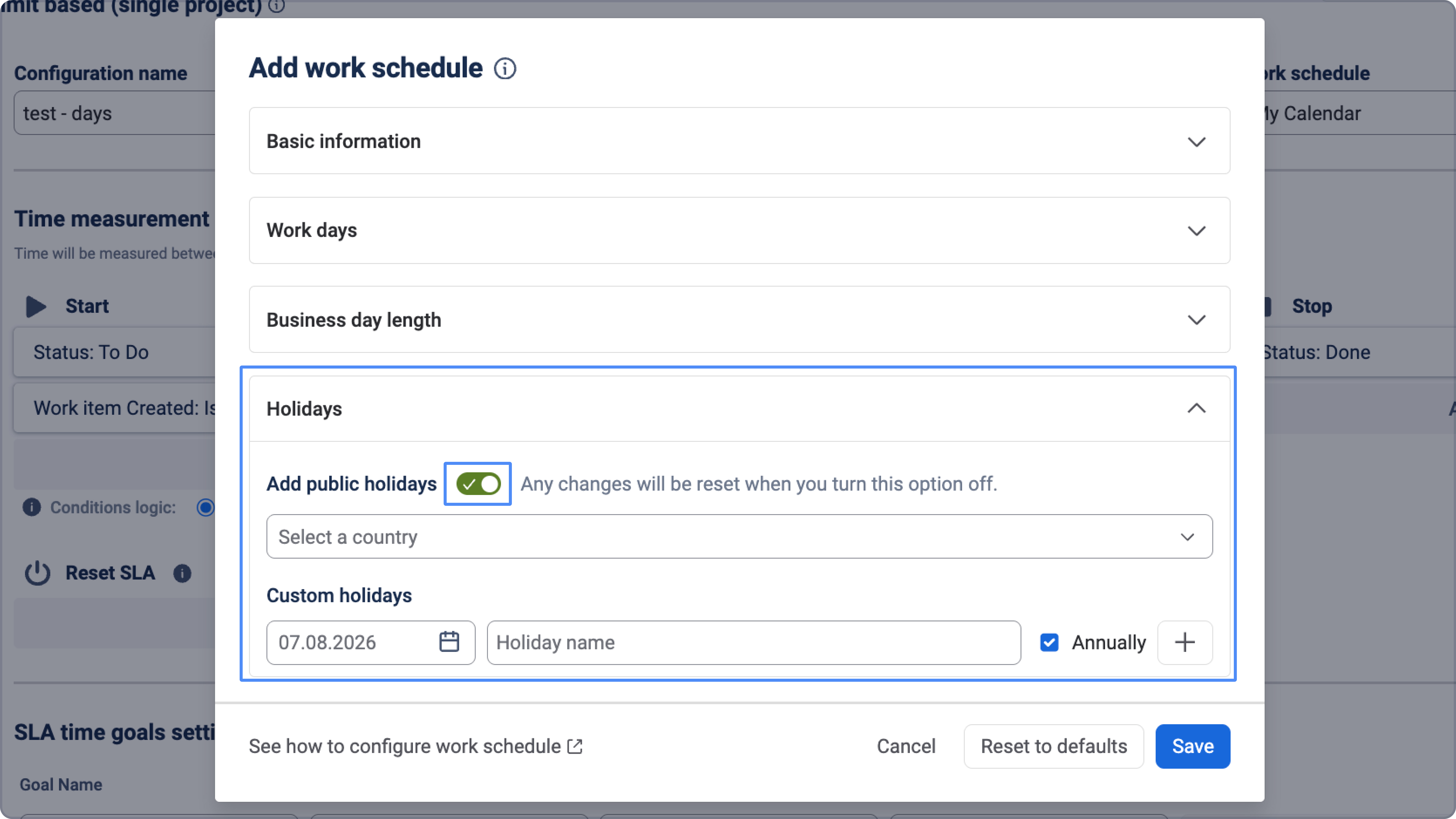
Public holidays are optional and are turned off by default. When the toggle is off, only manually added custom holidays are used.
After you turn on Add public holidays, select a country from the dropdown. The app may suggest a country based on the selected time zone when possible. If the country cannot be detected, you can select it manually.
After a country is selected, public holidays are loaded automatically and shown in the holidays list.
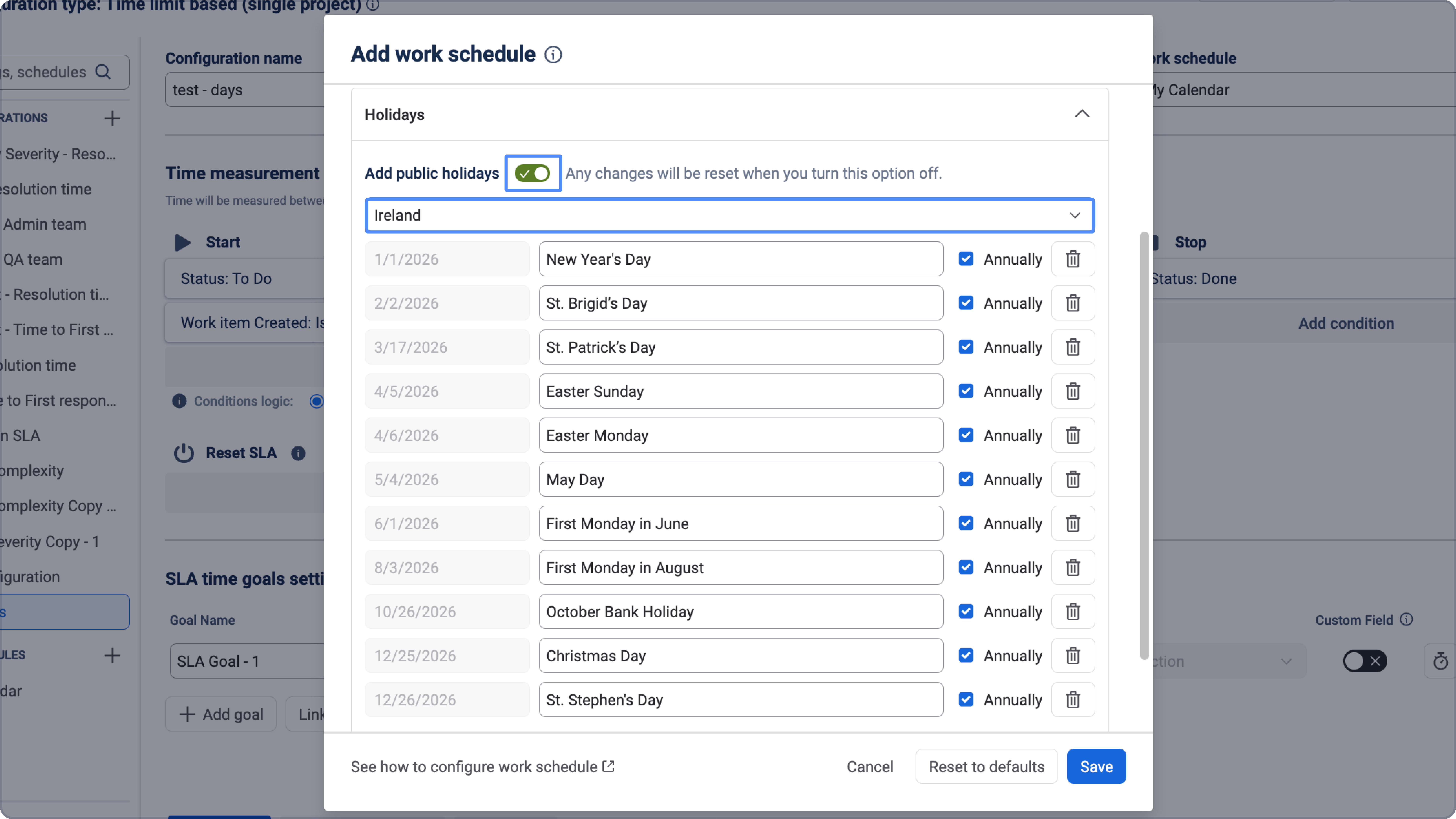
For public holidays, you can:
-
edit the holiday name
-
delete a holiday
-
enable or disable Annually
If you turn Add public holidays off and then turn it on again, the app restores the default public holidays for the selected country. Any changes made to public holidays are reset. Custom holidays are not removed.
Custom holidays
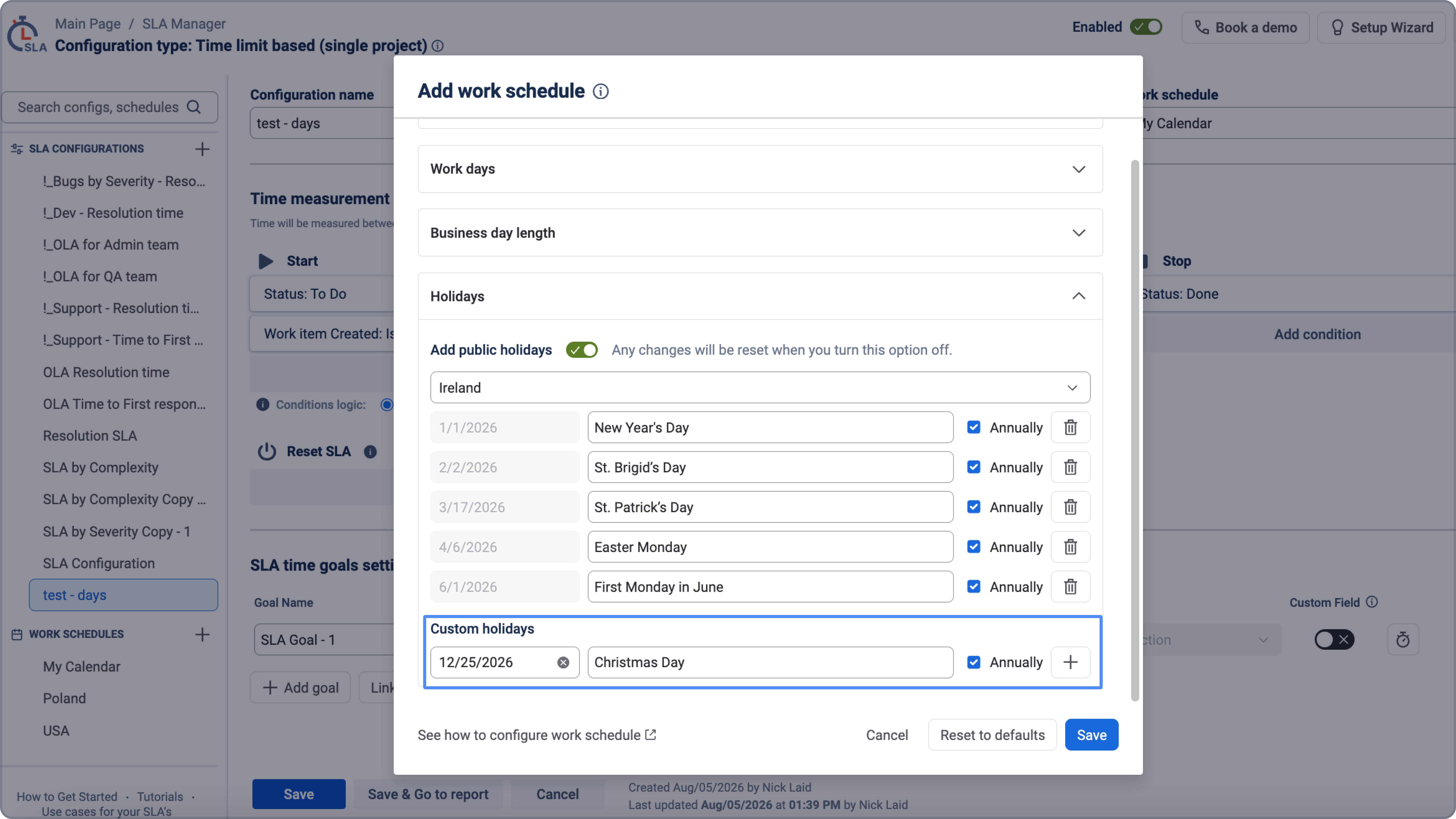
Use Custom holidays to add company-specific holidays, internal non-working days, or any other dates that should not be counted as working time.
For each custom holiday, you can:
-
select a date
-
add a holiday name
-
enable or disable Annually
-
edit the holiday
-
delete the holiday
Save and manage the schedule
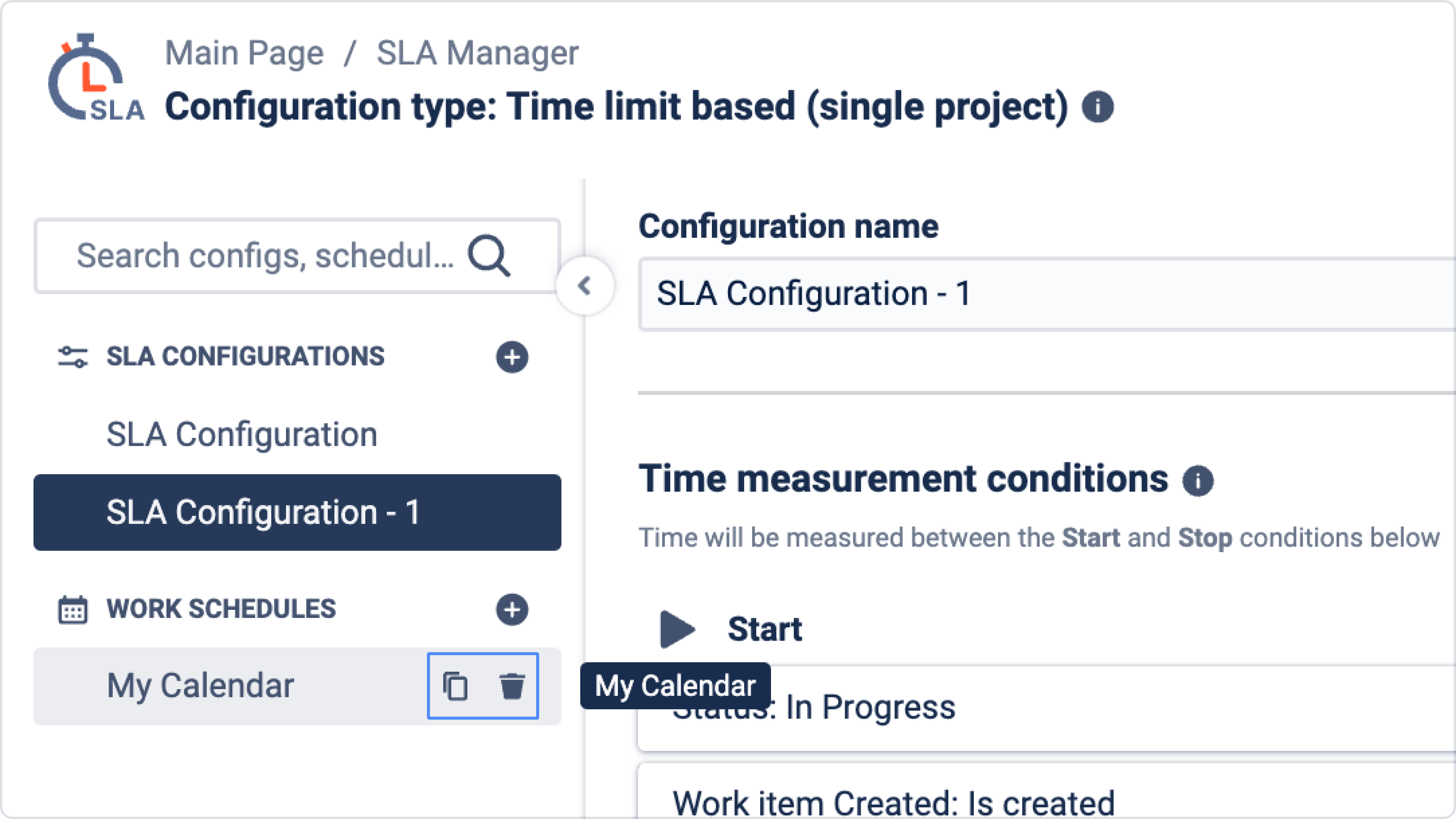
At the left menu bar of Configuration Manager – Work Schedules :Calendars:, you can view the full calendars list that has been created before. You can also create new, copy, and delete existing ones.
Important notes
-
SLA time is calculated using the selected calendar and working hours
-
Time zone affects SLA calculation
-
Calendars can be reused across multiple SLAs
-
Changes to a calendar may affect SLA results
When to use Multiple-scheduler (Available in the Advanced plan)
Use multiple calendars when:
-
teams work in different time zones
-
support operates in shifts
-
different services have different working hours
👉 Learn more: Multiple-scheduler SLA type
Need help?
Have questions or need help with SLA Time and Report? Contact our support team.
Want to see SLA Time and Report in action?
Book a demo with our team to explore your use case, or start a free trial to try the app in your Jira environment.